

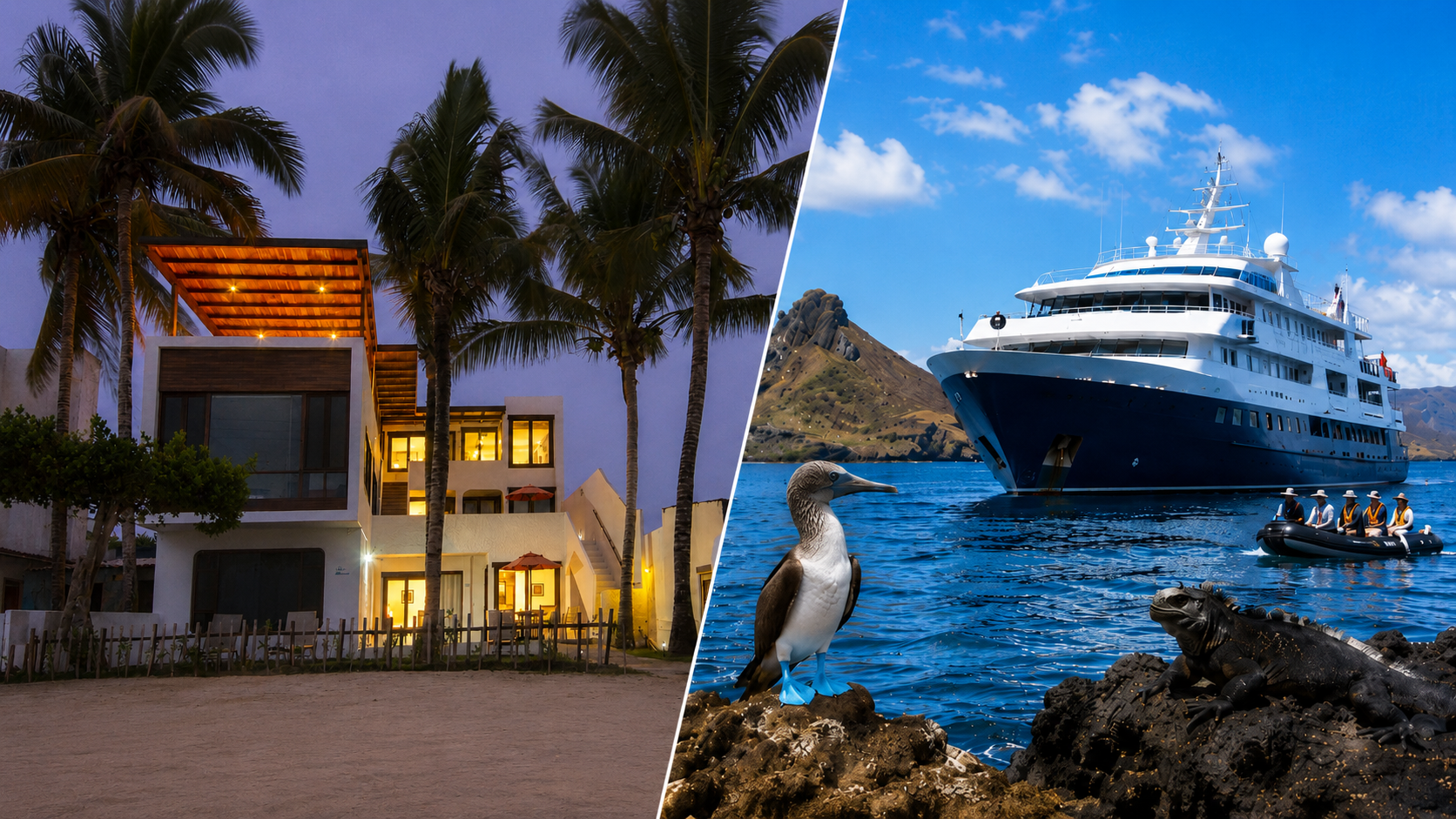
For many travelers, one of the first big questions when planning a Galápagos trip is simple: Galápagos hotel vs cruise, which is better?
The honest answer is that neither option is automatically better. A cruise and a land-based boutique hotel stay offer two very different ways to experience the islands. One is structured, efficient, and designed to cover more sites in less time. The other is more flexible, grounded, and connected to the everyday rhythm of the islands.
Your best choice depends on how you like to travel, your budget, your pace, and what kind of memories you want to bring home.
A Galápagos cruise can be ideal for travelers who want a fully scheduled itinerary, remote visitor sites, and the experience of sleeping at sea. A land-based Galápagos stay, on the other hand, is often better for travelers who want real rooms, natural light, local restaurants, island towns, flexible excursions, and a slower relationship with one or two islands.
This guide compares both options honestly: cost, wildlife access, flexibility, comfort, and who each travel style is right for.
What a Galápagos Cruise Actually Looks Like
A Galápagos cruise is usually the most traditional way travelers imagine exploring the islands. Guests sleep onboard a boat and follow a fixed itinerary designed around approved visitor sites. Each day is planned in advance, often with early wake-ups, guided landings, snorkeling stops, meals onboard, and navigation between islands.
The main advantage of a cruise is access. Cruises can reach remote and uninhabited islands that are not usually available on day trips from populated islands. For travelers whose priority is seeing as many visitor sites as possible in a short period of time, this can be a strong benefit.
Cruises also simplify logistics. Once you board, the schedule, meals, transfers, and excursions are handled for you. You do not need to decide where to eat each night, which tour to take the next day, or how to move between islands — for some travelers, this structure is exactly what they want.
But cruises also come with trade-offs. Cabins are usually smaller than hotel rooms. The pace can feel intense, especially for travelers who prefer slow mornings or more personal downtime. You are also tied to the route, the boat schedule, and the group rhythm. If you love flexibility, independent exploring, or spending time in local towns, a cruise may feel more limited.
A cruise is often best for travelers who prioritize coverage, remote sites, and a fully programmed experience over flexibility, local immersion, and hotel-style comfort.
What a Land-Based Boutique Stay Looks Like
A land-based Galápagos stay means sleeping in hotels on the habited islands and taking daily excursions by boat, bike, or on foot. Instead of living onboard, travelers use one or more islands as their base.
This style is especially appealing for travelers who want a more grounded experience. You wake up in a real room, step outside into an island town, walk to the beach, choose your own meals, and decide how active or relaxed each day should be. It feels less like passing through the islands and more like living them at a human pace.
At Opuntia Hotels, this approach is built around waterfront stays in San Cristóbal and Isabela. The group is a network of seaside hotels created to experience Galápagos from the inside, with properties that provide access to beaches, piers, and main island attractions.
A land-based stay also gives travelers more control. You can plan active days with snorkeling, hiking, cycling, or kayaking, then balance them with beach time, local dining, massage experiences, or quiet evenings by the ocean. This flexibility is one of the biggest differences between a hotel stay and a cruise.
Another advantage is connection to local life. When you stay on land, your trip includes restaurants, small businesses, guides, local teams, and the everyday rhythm of the island. For travelers who care about community-based tourism and conscious hospitality, this can make the experience feel more personal and meaningful.
The trade-off is that land-based stays generally focus on one or two main islands rather than many remote sites. You may not see as many islands as a cruise passenger, but you often experience the places you do visit more slowly and deeply.
Cost: Let’s Be Real
Cost is one of the biggest reasons travelers compare a Galápagos hotel vs cruise. But the comparison only makes sense when you look at what is included.
A mid-range Galápagos cruise can often run around USD 3,000–7,000 per person for 8 days, depending on the boat category, route, cabin type, season, and inclusions. Luxury cruises can be significantly higher. The price usually includes accommodation, meals, guided excursions, and navigation, but it may not include flights to Galápagos, park fees, transit cards, tips, some beverages, wetsuit rentals, or hotel nights before and after the cruise.
A comparable land-based boutique stay can typically run around USD 1,500–3,000 per person for 7 nights, including hotel nights and excursions, depending on the itinerary, room category, tours, transfers, meals, and season. This range can vary widely, but land-based travel often gives visitors more control over where they spend and where they save.
For example, travelers may choose a beachfront hotel for part of the trip, select only the excursions they truly want, eat at local restaurants, and adjust the pace according to their budget. Opuntia’s multi-island programs include guided tours, land and sea transfers, inter-island flight options, meal plans, selected massages, and accommodation in superior tourist-class hotels, with sample programs starting around USD 2,180–2,230 per person before taxes.
The key is not to compare only the total price. Compare value. A cruise may offer access to more remote sites and a fully packaged route. A land-based stay may offer larger rooms, more flexibility, local dining, and more freedom to design each day. For travelers who want comfort and control without the cost of a higher-end cruise, a land-based hotel itinerary can be a very strong alternative.
Wildlife Access: The Real Comparison
Wildlife is usually the heart of any Galápagos trip, so this question matters: can you see the same wildlife land-based as on a cruise?
The answer is: not exactly, but you can see a lot.
Cruises often reach more remote, uninhabited islands, which can offer exceptional wildlife encounters in places that land-based day tours do not access. This is one of the strongest arguments for choosing a cruise.
However, land-based travelers can still experience many of the core Galápagos species and landscapes: sea lions, marine iguanas, sea turtles, rays, reef fish, blue-footed boobies, giant tortoises, volcanic landscapes, beaches, wetlands, and snorkeling sites. In San Cristóbal, travelers can access places like Kicker Rock, Playa Mann, Tijeretas, La Lobería, and the Interpretation Center. In Isabela, visitors can experience Los Túneles, Las Tintoreras, Sierra Negra, wetlands, beaches, and giant tortoise areas.
The difference is not only what you see, but how you see it. A cruise may allow you to visit more sites across more islands. A land-based stay allows you to return to the same beach, walk through the same town, recognize the rhythm of the waterfront, and experience wildlife as part of daily life. You may not cover as many locations, but the experience can feel more intimate and less rushed.
For many first-time visitors, the land-based wildlife experience is more than enough, especially when combined with strong day tours and a thoughtful multi-island route.
Who Each Option Is Right For
A Galápagos cruise is usually right for travelers who want a highly structured itinerary. It works well for people who like having every day planned, want to visit remote islands, and are comfortable sleeping onboard. It is also a good fit for travelers who want to maximize the number of visitor sites and do not mind a fixed pace.
A cruise may be less ideal for travelers who get seasick easily, prefer larger rooms, want flexibility, or enjoy choosing where to eat and how to spend each evening.
A land-based boutique stay is usually right for travelers who want flexibility, comfort, and a deeper connection with the islands. It works well for couples, families, solo travelers, and small groups who want to balance adventure with rest.
It is especially good for travelers who want:
- Real hotel rooms with more space and natural light.
- The option to choose excursions day by day.
- Local restaurants and island-town atmosphere.
- More control over budget and pace.
- A slower, more grounded experience.
Opuntia Hotels fits this style because its portfolio connects San Cristóbal and Isabela through properties with different personalities: Casa Opuntia on the waterfront in San Cristóbal, Casita de la Playa directly on the beach in Isabela, Volcano Hotel near the beach and center of Puerto Villamil, and Casa Baronesa as a more private residential-style retreat in Isabela.
For many travelers, the best answer is not “hotel or cruise” in a generic sense. It is about choosing the format that matches how you want to feel during the trip.
The Multi-Island Land-Based Option
Opuntia’s multi-island itineraries are designed around this idea, combining guided excursions, transfers, meals, selected wellness moments, and hotel stays across the islands. These programs are created for travelers seeking variety, comfort, iconic wildlife, trekking, snorkeling, and oceanfront relaxation.
This is where a boutique hotel stay becomes more than a simple alternative to a cruise. It becomes its own way of traveling: flexible, conscious, comfortable, and connected to the islands from within.
Frequently Asked Questions
Galápagos boutique hotel vs cruise — which is better for first-timers?
It depends on what you value. Cruises cover more islands and more sites in less time. Land-based boutique stays go deeper on one or two islands with more flexibility, lower cost, and a slower pace. First-timers who want to feel the Galápagos rather than check it off tend to prefer land-based.
How does the cost of a boutique hotel stay compare to a Galápagos cruise?
A mid-range Galápagos cruise runs around USD 3,000–7,000 per person for 8 days. A comparable boutique land-based stay, with 7 nights and excursions included, typically runs around USD 1,500–3,000 per person. The final cost depends on season, room type, tours, transfers, and inclusions.
Can you see the same wildlife land-based as on a cruise?
Not identical, but the core wildlife is accessible from land: sea lions, marine iguanas, blue-footed boobies, sea turtles, hammerhead sharks at Kicker Rock, and flamingos. Cruises reach more remote uninhabited islands; land-based guests see inhabited islands more thoroughly.
What’s the advantage of a land-based stay in the Galápagos?
Flexibility, pace, and cost. You choose your excursions each day rather than following a fixed ship itinerary. You sleep in a real room with natural light. You eat local food. And you spend significantly less for a comparable amount of comfort.
Which boutique hotels offer multi-island stays in the Galápagos?
Opuntia Hotels is a boutique hotel group with properties on both San Cristóbal and Isabela, making it a strong option for a land-based multi-island stay without changing hotel groups. Travelers can combine Casa Opuntia in San Cristóbal with Casita de la Playa, Volcano Hotel, or Casa Baronesa in Isabela.